

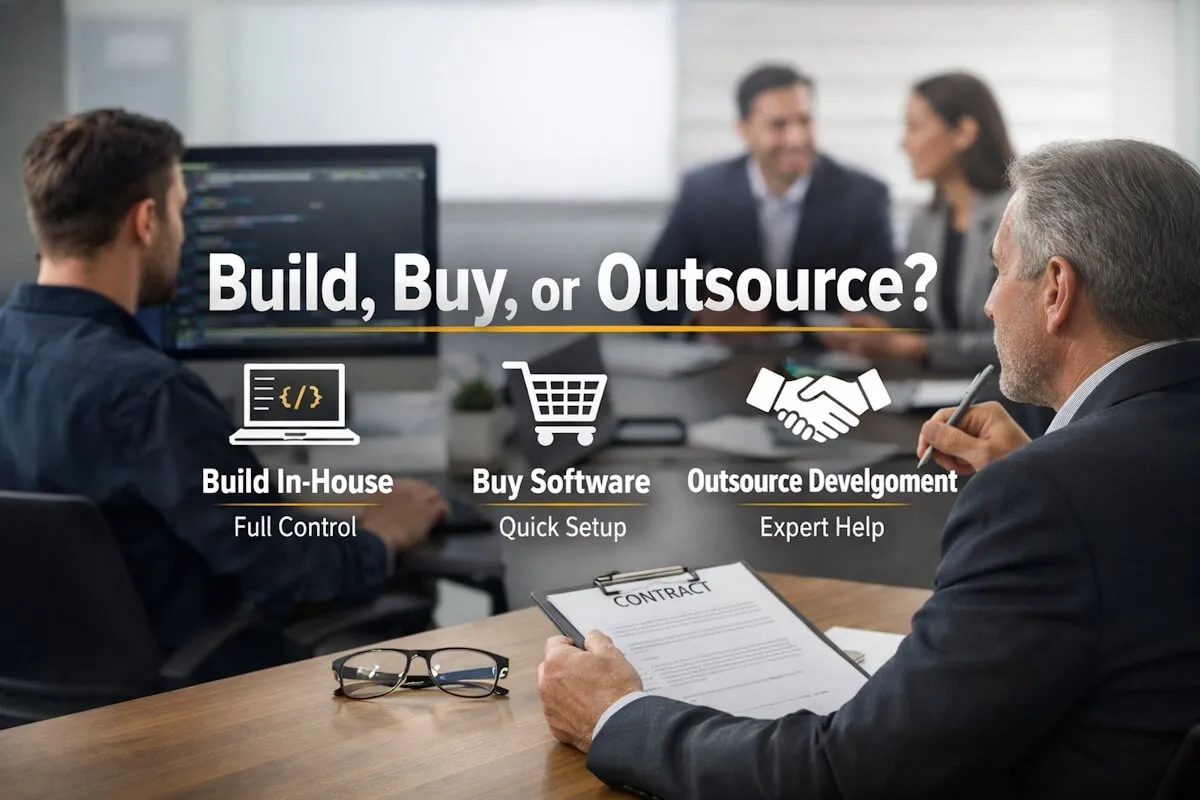
Running a company means making calls that shape the future. Some decisions feel obvious. Others sit in a gray area and keep coming back. One of those is this: should you build your own software, buy an existing solution, or outsource the work?
There’s no single right answer. It depends on your stage, your budget, your team, and honestly, your tolerance for risk. Still, you need a clear way to think through it. That’s what this guide is about.
Let’s break it down in a way that actually helps you decide.
Why This Decision Matters More Than You Think
You’re not just choosing how to get software built. You’re deciding how your business will operate for years.
Pick the wrong path and you may:
- Burn through budget faster than expected
- Delay your product launch
- End up with something that doesn’t scale
- Lock yourself into tools that limit growth
Pick the right one and things click. Your team moves faster. Costs stay predictable. You focus on what really matters.
So yeah, this is worth thinking through carefully.
Option 1: Building In-House
Building in-house sounds appealing. You own everything. You control every detail. No dependency on external teams.
But let’s get real for a second.
What Building In-House Actually Looks Like
You need to:
- Hire developers, designers, and maybe a product manager
- Set up infrastructure
- Manage timelines and workflows
- Handle testing, deployment, and maintenance
This is not a one-time effort. It’s ongoing.
When Building Makes Sense
Building in-house works best when:
- Your product is your core business
- You need full control over features and roadmap
- You have the budget to hire and retain talent
- Speed is not your only priority
Think about companies where the software itself is the product. In those cases, building is often the right move.
The Hidden Challenges
Here’s what often gets overlooked:
- Hiring takes time. Good developers are not easy to find
- Salaries add up quickly
- Managing a tech team requires experience
- Scaling the team later can get messy
If you don’t already have strong technical leadership, building in-house can feel overwhelming fast.
Option 2: Buying Off-the-Shelf Software
Buying is the quickest way to get started. You pay for a ready-made solution and start using it.
Simple, right?
Well, mostly.
What Buying Looks Like
You:
- Choose a product
- Set it up
- Train your team
- Start using it
Many tools today are plug-and-play. You can be up and running in days.
When Buying Makes Sense
Buying works well when:
- Your needs are standard
- You don’t need deep customization
- Speed is critical
- Budget is limited
For example, using CRM tools, accounting software, or HR systems. These are common use cases with plenty of solid options available.
Where Buying Falls Short
At some point, you may hit limits:
- Features you need are missing
- Customization is restricted
- You depend on the vendor’s roadmap
- Costs increase as you scale
You may also end up adjusting your processes to fit the tool, instead of the other way around.
That’s not always ideal.
Option 3: Outsourcing Development
Outsourcing sits somewhere in the middle. You don’t build everything yourself, but you don’t settle for rigid tools either.
You work with an external team to build what you need.
What Outsourcing Looks Like
You:
- Define your requirements
- Partner with a development company
- Collaborate on design and development
- Launch and iterate
The right partner becomes an extension of your team.
When Outsourcing Makes Sense
Outsourcing works well when:
- You need custom software but don’t want to build a full team
- Time to market matters
- You want access to experienced developers
- You need flexibility without long-term hiring commitments
Many CEOs lean toward this model because it balances control and speed.
Why Many Businesses Prefer This Route
Outsourcing gives you:
- Access to skilled talent without hiring headaches
- Faster development cycles
- Predictable costs
- Flexibility to scale up or down
If you’re exploring this path, working with providers offering IT Consulting Services can help you shape the right strategy before development even starts.
And if you want to go deeper, you can also Hire IT Consultants who bring focused expertise to guide decisions, architecture, and execution.
Comparing the Three Options Side by Side
Let’s simplify things.
Control
- Build: Full control
- Buy: Limited control
- Outsource: Moderate to high control
Cost
- Build: High upfront and ongoing
- Buy: Low upfront, ongoing subscription
- Outsource: Moderate and predictable
Speed
- Build: Slow
- Buy: Fast
- Outsource: Faster than build, slower than buy
Flexibility
- Build: High
- Buy: Low
- Outsource: High
No option wins in every category. That’s the point.
Questions Every CEO Should Ask Before Deciding
Instead of jumping to a choice, ask yourself a few direct questions.
1. Is This Core to My Business?
If the software defines your product or gives you a serious edge, building or outsourcing makes more sense.
If not, buying might be enough.
2. How Fast Do I Need This?
Need something live in weeks? Buying is your best bet.
Can you wait a few months for a tailored solution? Outsourcing fits well.
Planning long-term with no rush? Building is an option.
3. What’s My Budget Really Like?
Be honest here.
Building costs more than most people expect. Not just development, but hiring, retention, and management.
Outsourcing keeps things more controlled.
Buying looks cheap at first but can get expensive over time.
4. Do I Have Technical Leadership?
If you don’t have someone who understands development deeply, building in-house can get risky.
Outsourcing with the right partner can fill that gap.
5. How Much Flexibility Do I Need?
If your needs are likely to change often, avoid rigid systems.
Custom development, whether in-house or outsourced, gives you room to adapt.
A Practical Way to Decide
Still unsure? Try this simple approach.
Step 1: Define the Problem Clearly
What exactly are you trying to solve?
Write it down. Keep it specific.
Step 2: List Must-Have Features
Not everything. Just what you can’t do without.
Step 3: Check Available Tools
Look at existing products. Do they meet your needs?
If yes, buying might be enough.
Step 4: Evaluate Internal Capabilities
Do you have the team to build this properly?
If not, outsourcing becomes more attractive.
Step 5: Run a Cost Comparison
Estimate:
- Hiring costs
- Tool subscription costs
- Outsourcing costs
Compare them over at least 12 to 24 months.
This often reveals the real picture.
Common Mistakes to Avoid
A lot of CEOs make similar mistakes here.
Chasing Control Too Early
Building just for control can slow you down.
Sometimes speed matters more.
Underestimating Costs
Building is rarely cheap. It adds up quickly.
Overbuying Features
Buying tools with tons of features you don’t use is wasteful.
Choosing the Wrong Partner
In outsourcing, the partner matters a lot. A poor fit can delay everything.
So, What Should You Do?
There’s no universal answer.
If your software is your product and you have the resources, build.
If you need something quick and standard, buy.
If you want a balance of speed, flexibility, and cost control, outsource.
Most businesses don’t stick to just one approach forever. You might start by buying, move to outsourcing, and eventually build in-house.
That’s normal.
The Real Takeaway
This decision is not about what’s popular. It’s about what works for your business right now.
Think about your goals. Your constraints. Your timeline.
Then choose the path that gets you moving without slowing you down later.
Because at the end of the day, it’s not about how the software gets built.
It’s about what it helps you achieve.